Monday, 20 February 2012

The Battle of Ledbury

Even though I was unable to attend the biggish game, I did help organise it, and thus claim the right to blog about it!

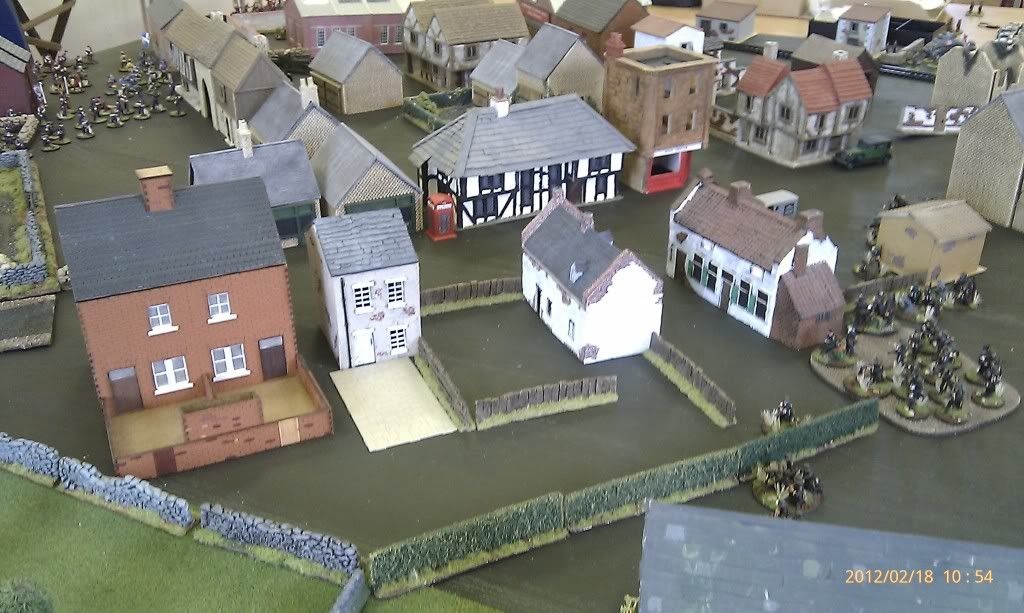
The rural area.
It seems that a great time was had by all – which is the main thing! Due to drop outs, the two table set-up was reduced to single large table; 18x6, with a 6x6 urban area as Ledbury, the rest was rural, with a long road heading toward the town.

The urban area.

The battle saw Fascist/Royalist forces (including BUF, the Shrewsbury School battalion and armed Morris dancers) take on an Anglican League/socialist coalition (including Canadians and Abyssinians!). The Fascist/Royalists launched a blitzkrieg along the road, while a force of cut-off BUF also battled through the town at the other end. The AL/socialists in Ledbury fought back bravely and both sides took heavy casualties, with machine guns, artillery and armour adding to the destruction.

BUF advance into Ledbury

The result was something of a stalemate – at best a pyrrhic victory for the Anglican League, who held the town but were severely mauled.

What will happen next? Did the Canadian ‘tourist’ (actually an anti-government spy) get rescued? Did the player who commandeered all the ladders for house-to-house fighting return them all? Only time will tell.

The Canadians counter-attack

Thanks to Rob and Tym for allowing me to bring you these smashing photos of the game, more details of which can be found here, here, here, here and in Rob’s blog here.

Royalist blitzkrieg!
Anti-government forces
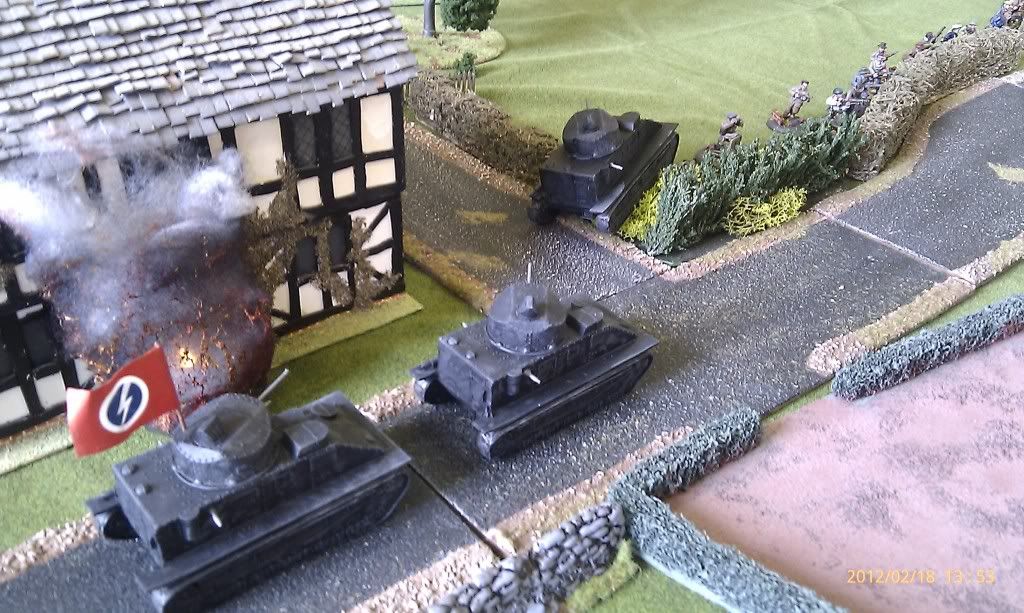
Socialist armour gets a good pasting
Abyssinians
Fascist HQ
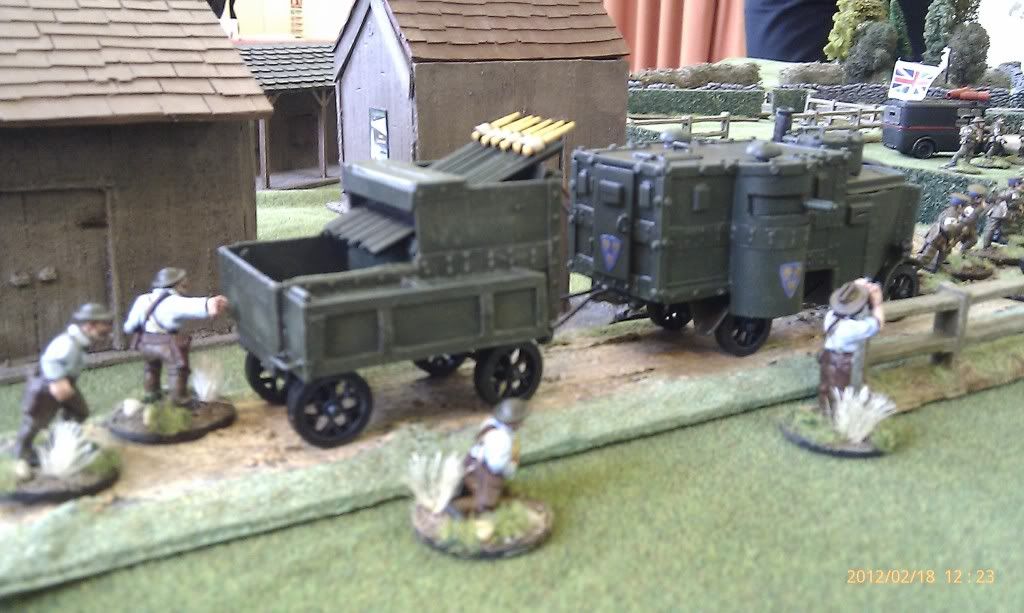
Royalist steam powered improvised rocket battery
The manor takes a direct hit
I hope that any attendees who are reading this enjoyed the takeaway curry I organised for you. Here's to the next game!

Saturday, 18 February 2012

Stand down chaps, stand down

Well, the best laid plans of mice and men oft go up the spout, and so it proved today.

My participation in the big-ish game was scuppered due to the unfortunate lurgie that has gripped my family. And so instead of helping to umpire the game, I've spent the day on nursing duty.

This does however give me some time to take photos of some miniatures I had hurriedly painted in readiness for the big(ish) event.

Here they are, the newly uniformed and equipped Monmouthshire English company, now fully incorporated into the BUF Three Counties Legion.

All dressed up and nowhere to go...
Figures are Warlord Games (ex BEF) Belgians, with a Great War miniatures officer.

And to redress the balance a little, a support team for the Archenfield Amatuer Athletics Association, with one of those new fangled Czech LMGs.


This one is a Westwind 8th Army Bren gun team.

It's a damn shame that I couldn't get to the biggish game, but the health of my family is of course of far greater importance!

Monday, 13 February 2012

Countdown to the Battle of Ledbury

Regular readers of this blog will know that Giles and myself have been setting our VBCW campaigns in the Ledbury area. As things stand the royalist/BUF forces have been making small gains against the anti-government Anglican League’s push from Ross to Ledbury. The town is now under siege, although some of the besieging forces are cut off.

The scene is thus set for our first big(ish) game, where fellow VBCW gamers will gather this Saturday to settle the question of who controls this gateway to the Malverns once and for all!

The scenario (written by Giles) is :-

After a series of skirmishes, the BUF forces operating out of the Malvern Hills area have been pushed back towards the town of Ledbury in Herefordshire, south west of the Malverns. The BUF have incurred the wrath of the local LDVs such as the Malvern Hills Conservators (MHC) even though they (the MHC) are nominally supportive of the King in his court at Madresfield outside Malvern.

To make matters worse, the Anglicans operating out of Ross-on-Wye have decided to seize this opportunity to push the BUF back out of southern Hereford and link up with various factions operating in the region. Short of supplies and with rebellion behind them the BUF decide to consolidate their forces south west of Malvern requiring them to take Ledbury back for the King and Mosley.

The BUF forces are split into two groups:
• The first is about to break into the outskirts of Ledbury in order to quell local dissent and make their way back to their bases around Malvern to re-supply. They are now short on fuel and ammo. They face urban combat for the first time.
• The second is a newly despatched force from Bromyard that is approaching Ledbury for their first combat and need to overcome the outer defences and then join up with their fellow Blackshirts in Ledbury itself.

The defenders of Ledbury are fewer in number, but have the benefit of prepared defences, and better supplies. Royalist forces may choose which side to fight on depending on their history/background(err on the side of the BUF), Anglicans and Reds on the side of the Ledbury defenders

The action takes place on two tables:

1. This represents the BUF having penetrated the outer defences and engaged in urban combat.
2. This represents the new BUF forces from Bromyard having to fight their way into Ledbury.

Events on Table 1, will influence events on Table 2

Table 1 - the 'urban' game

Table 2 - the 'rural' game (seperated from table 1 by the railway line)
Players have been given a number of clues (and the odd red herring), based on fictitious newspaper reports (partially based on the pre-game writings of some of the participants):-

The Hereford Clarion – Evening Edition

Ledbury remains defiant!

Despite increasing BUF gains in the east of the county, anti-government forces holding the town of Ledbury have refused to surrender their arms and pledge loyalty to the King.

The forces of the Anglican League have garnered considerable local support, with bands of rebels from the Malvern Hills gathering under the Anglican banner. However government forces, while partially cut off from their headquarters, have pledged to ‘clear out this next of vipers’ and return the market town to royalist control.

The Anglicans are said to be gathering reinforcements from far and wide, while the BUF Three Counties Legion and their allies King Offa’s Legion are similarly bolstering their forces. Fighting has intensified in the area in recent weeks and Ledbury, once the picturesque gateway to the land of Edward Elgar, now bristles with barricades and sandbags.

Will the town fall without a fight, or will the battle be long and bloody? Only time will tell?

Mystery scarecrows

More strange straw effigies have appeared in the Ledbury region this week. Sinister scarecrows have sprung up in a number of fields and allotments. In an intriguing development, one particularly frightening mannequin appeared at the top of the Herefordshire Beacon. A note bearing the legend ‘King Twiggy will not stand idly by’ is said to have been attached to this creature.

Malvern stirs

The chaos of civil war in Herefordshire has been further muddled by forces from across the border in Malvern. The Malvern Hills Conservators, although avowed supporters of the King, have famously fallen out with the BUF in recent times.

However, it should not be assumed that the MHC will naturally spring to the defence of Ledbury, for rumours abound of a split between the Conservators and the Anglican League following the loss of Colwall.

On a more exotic note, the former Emperor of Abyssinia, living in exile in Malvern for some considerable time, has showed his hand by declaring is defiance against ‘all forms of fascism, be it in my own country or that of my gracious host.’

It seems that Herefordshire will not only resound with the hearty yells of the British yeoman, but also the war chants of the African warrior!

Traffic news

The county-wide highways improvement scheme continues, with much disruption to traffic entering Herefordshire. Drivers of large vehicles wishing egress into the county should beware of large delays and diversions.

Despite the threat of fighting, gas works are continuing along the high street of Ledbury. Motorists should expect disruption.

Stoke Edith girl crowned Miss Herefordshire

The coveted title of Miss Herefordshire has been won by Ms. Edith Blistford of Stoke Edith. Ms. Blistford, 46, wept with happiness as she was crowned at a glittering ceremony at Eardisland village hall. ‘I’ve never been so happy’ sobbed the former blacksmith’s assistant.

However critics of the competition have blasted Ms. Blistford’s victory, especially after judges admitted that she won the swimsuit round hands-down. ‘It was so one-sided,’ complained one onlooker, ‘she was easily the youngest contestant there.’

Ledbury latest: Reds flock to the defence!

Forces loyal to His Royal Highness have pledged to ‘seek out and destroy all traces of the red menace that dares to disrupt our quaint countryside’ today, after reports that at least two columns of communists are en-route to join the defenders of Ledbury.
Sources in the Midlands have confirmed that the Red Brigades of the Stourbridge Socialist Party and, from further afield, the Canadian Socialist Army are already on the march, intending to join the growing ranks of ‘traitors and rebels’ that are manning the barricades at the beleaguered town.

Our Ledbury correspondent reports that morale is high among the defenders, although local commanders were visibly disappointed yesterday following an inspection of the town’s sewerage system. Anglican League authorities maintain that this was purely an inspection for sanitary reasons and not, as has been suggested, down to the fact that a senior officer accidently dropped plans of the defences down the privy last week.

Meanwhile the royalists in Hereford have assured worried citizens that plans are in motion to beef up the besieging force, including the famous BUF XII Legion, although this correspondent has yet to see any evidence of reinforcements.

Scarecrow festival seeks funds

Organisers of the annual charity scarecrow festival at Bromyard have issued a plea for donations.

‘Without adequate funds we will be unable to hold an event this year,’ said a spokesman, ’as the license fee for holding public events has increased significantly under the new regime.’

Anyone wishing to make a donation may do so by contacting this correspondent. Organisers have pledged to give their wholehearted support to whoever makes the largest donation.

Fuel shortage continues to bite

The shortage of fuel that has dogged the county since the beginning of the war is continuing to cause chaos along the highways and byways.

Supplies of oil and petrol began to dry up following the former Bishop of Hereford’s declaration for the Anglican League and Herefordshire came under blockade. Hopes that fuel would begin to flow again once the county was liberated proved illusory however. ‘I’ve never seen Hereford so free of traffic’ said one local, ‘it takes me next to no time to get to work, although the chances of being hit by a bike have trebled.’

As businesses turn from horsepower to horse power, farriers, carters and wheelwrights have reported a strong upsurge in business. ‘I’ve never been so busy’, declared a Withington blacksmith, ‘the horse is certainly king ‘round these parts!’

Ladder stolen

Much Marcle window cleaner Albert Figgis has issued a heartfelt plea for the return of his missing, presumed stolen, ladder.

‘I was out and about on my rounds when I popped into the Feathers Hotel for a restorative, prior to going to work on the rectory in Ledbury on Monday. When I came out, my bike was still there, but my ladder had gone!’

‘I’ve had the same ladder for over thirty years, man and boy,’ he said. ‘It’s like losing an old friend. I’ve tried to buy a new one but you can’t get ‘em for love nor money nowadays.’

Rail problems add to travel woes

GWR have announced that the Worcester – Hereford line will be closed due to a landslide at the Wyche Cutting, where the railway passes through the Malvern Hills.

Rail travel within Herefordshire is also restricted due to a number of broken down armoured trains, suspect packages and leaves on the line. Rail officials are confident that the trains and packages will be cleared within the month. ‘The leaves may take a little longer’, said a spokesman.

Missing tourist

A Canadian tourist has been reported missing whilst staying in the restless Ledbury region, it has been revealed.

Captain Corbett, on leave from the Royal Canadian Mounted Police, was believed to be travelling through the area as part of a motoring holiday through Wales and Shropshire. Planning to venture further south, fuel shortages forced him to temporarily pause his journey at a B&B near Colwall.

He was last seen attending the village fete, where witnesses report him sharing a flagon of cider with the leader of a travelling troupe of Morris dancers, who had been entertaining the crowd with their traditional dancing.

Police are currently attempting to ascertain Captain Corbett’s whereabouts and would welcome any information.

Black Country Blackshirts beat deadbeat Reds!

News has reached this correspondent of a decisive battle between the Stourbridge Socialists, who were last reported to be en-route to the Ledbury front, and the Wolverhampton BUF.

The Blackshirts, also believed to be on their way to bolster the King’s forces in Herefordshire, clashed with the socialists at Cradley and, according to one witness, gave them ‘a bostin good cogwinder’. The reds are believed to have retreated to Birmingham, leaving the Wolverhampton BUF victorious.

Rumours that the BUF have captured a number of socialist vehicles and are planning to use them in the oncoming battle of Ledbury have yet to be substantiated, but if true, will be a major blow to the Anglican League and their allies.
The build-up to the biggish game can be followed here.

I’ve never hosted or umpired a game before, so fingers crossed that all goes well!

Tuesday, 31 January 2012

The Herefordshire Light Infantry Museum

The second half of my museum day saw me at the Herefordshire Light Infantry Museum – an appointment only venue at Hereford's TA centre.


This is a great little museum, and I am indebted to David of Sunset Militaria for showing me around and imparting some of his expert knowledge. The Museum contains artefacts relevant to the Hereford Rifle Volunteer Corps (HRVC) (1860-1908), Herefordshire Regiment (1908-47) and Herefordshire Light Infantry (1947-68).


Highlights include pennants from the car of Grand Admiral Doenitz, the 2nd Fuehrer of the 3rd Reich – rescued from the officer’s mess and now given pride of place in the museum!


On display are numerous regimental standards, uniforms, cap badges at the like from the regiment’s long and distinguished history, alongside many bits and bobs ranging from photographs and drums to helmets and regimental crockery! There are also plenty of medal sets, including some rare groupings, for collectors to drool over and having such a knowledgeable guide, like David and the other trustees, adds a whole new dimension to the visit.


The Herefordshire Light Infantry Museum deserves all the support it can get and I heartily recommended making an appointment (a simple email does the trick). It is the trustees’ aim to build a larger museum dedicated to Herefordshire’s oft-overlooked military history, from its Napoleonic Volunteer militias to the SAS, and I for one fully endorse this!


A brief history of the Herefordshire Light Infantry


While Herefordshire’s connection with the regular army ended in 1881, when the 36th (Herefordshire) regiment became the 2nd Battalion, The Worcestershire Regiment, the county has a venerable association with volunteer regiments. Companies of militia and yeomanry have been raised in Herefordshire since before the Napoleonic wars and the Herefordshire Light Infantry TA proudly carried on that heritage.


The militia barracks building at Harold Street is dated 1856 and more buildings were acquired in 1890. There was a drill hall in Widemarsh Street up until the 1880’s, which was presumably superseded by a drill hall at Friars Street, which remained in use for some time. During the period other drill halls could be found scattered among the towns and villages of Herefordshire. The Harold Street barracks later became home to the county records office, with the new Suvla TA Barracks opposite.


The 1st Administrative Battalion, Herefordshire and Radnorshire Rifle Volunteers was formed in 1861, comprising  the 1st to 8th Herefordshire Rifle Volunteer Corps and the 1st to 3rd Radnorshire Rifle Volunteer Corps. In 1880 it was re-designated 1st Herefordshire (Hereford and Radnor) Rifle Volunteers and became the volunteer battalion of The King's (Shropshire Light Infantry) the next year, beginning its long association with the KSLI.


The regiment's first taste of active service came in 1900, when two Volunteer Service Companies were formed from the three Volunteer Battalions of the KSLI, of which the Herefordshire Rifle Volunteer Corps was one, to reinforce 2nd Battalion KSLI in South Africa during the Boer War. In 1908, the regiment was transferred to the Territorial Force and the title of the Regiment was changed to 'The Herefordshire Regiment TF' (although it retained two companies in Radnorshire).


In World War I the regiment was expanded to three battalions. The 1st Battalion was mobilised as part of 158 Brigade in 53rd (Welsh) Division and fought at Gallipoli, Egypt, Palestine and the Western Front. The 2nd and 3rd battalions did not see active service and were eventually absorbed into 4h (Reserve) Battalion KSLI.


The 1st battalion fought with distinction in the Great War, for example being mentioned in dispatches following the landing at Suvla Bay:-

"Some of the units which took part in this engagement acquitted themselves very bravely. The Divisional Commander speaks with appreciation of one freshly landed battalion of 53d Division, a Herefordshire battalion, which attacked with impetuosity and courage."


The battalion went on to fight in the battles of Rumani, Gaza, Beersheba, Khuweilfek, and Tel Asur, before being transferred to the western Front as part of 102 Brigade in 30 Division. Here they participated in the battles of the Marne and 3rd Ypres, earning another special mention following action near Menin:-

"Congratulations to you and all ranks of your splendid Battalion for the excellent work done during the three days fighting."


Following the armistice and a stint of garrison duty in Germany, they returned to Hereford and were demobilised in 1919. In 1920 the Reserve army was reorganised into the Territorial Army and the regiment became the Herefordshire Regiment TA, losing its Radnor companies and thus severing the long-held ties with that area. The regiment re-joined the 53rd (Welsh) Division as part of the 159 (Welsh Border) Brigade, alongside the 4th Battalion KSLI and 3rd Battalion the Monmouthshire Regiment (this after an unsuccessful attempt to turn the Herefords into a heavy artillery regiment).


The interwar years saw the regiment settling down to normal peacetime duties, including attending camp and participating in various sporting competitions, but by the late 1930's it began to modernise in preparation for another world war.


In 1939 the regiment doubled in strength, splitting up into two battalions. While the 2nd battalion was involved in anti-invasion duties and never saw action, the 1st battalion, following postings to Tenby and Northern Ireland, was reorganised with the rest of 159 Brigade into a Lorried Infantry Brigade, joining 29 Armoured Brigade in 11th Armoured Division.


Originally intended for service in North Africa, the Division eventually saw action during the Normandy landings and in Operations 'Epsom', 'Goodwood' and 'Bluecoat' and the battles around the Falaise pocket. They then participated in the thrust into Holland and fought through NW Europe, eventually reaching the Germany's Baltic Coast. Their last action was during 'Operation Blackout', where members of the Herefordshire Battalion saw the surrender of Grand Admiral Doenitz, the 2nd (and last) Fuehrer of the 3rd Reich.


Post-war reorganisations saw the Battalion reformed in 1947 to the Herefordshire Light Infantry (TA), reflecting its long association with the KSLI. The battalion continued to thrive but sadly ceased to exist after a reorganisation of the TA in 1967. Its battle honours have since been incorporated into the Light Infantry TA, a platoon of which is still stationed in Hereford.


For more information, see here and here, and this frankly fantastic forum thread here.

The VBCW perspective


Like all Territorials, the men of the Herefordshire Regiment would have had their loyalties torn at the outbreak of civil war: duty bound as soldiers to serve the King but also obliged to defend their land and loved ones against oppression.


For a loyal regiment with such a distinguished martial tradition, it might be difficult to see how they would have rebelled against the government but when the Bishop of Hereford declared for the Anglican League, members of the Herefordshire TA fought for him in some of the early battles.


In the end it must go down to the political and/or moral stance of each man and his officers. Some would have felt strongly enough to join the Anglican League, others would have marched to the nearest royalist unit, while I suspect a great many would have simply headed for home, taking their weapons and equipment with them.


This state of affairs would be a sad and ignominious end for the Regiment, and as such I invented the ‘Hereford Bulls Veterans Association’ in my first piece on VBCW Herefordshire to bring back some of their spirit and reputation. After visiting the museum I concluded that this is not enough and so, sooner or later, you will see the Herefordshire Regiment, properly represented in miniature form in this blog, ready to do battle!


Monday, 30 January 2012

Command groups

So I had a few miniatures knocking around that I planned to use in various command groups – here they are painted up!

BUF command


These three go with the BUF standard bearer I knocked up for the Evesham game and will eventually form part of the Herefordian arm of the Three Counties Legion.
L – R: Gary Mitchell Miniatures’ ‘Mrs. Plumber’ as propaganda officer, Gary Mitchell Miniatures’ ‘Richard III’ for C.O. and Musketeer’s BUF commander (which I'll probably use for a company C.O.)

Municipal command


Three chaps who will lead the Hereford City Municipal LDV battalion.
L – R: Hasslefree’s ‘Prof. Beattie’ as a medic, Wargames Foundry’s Victoriana mayor as C.O. and a converted Artizan Maquis fighter as standard bearer.

Anglican League command


Fresh from Ross-on-Wye, this lot will march at the head of my AL battalion.
Front row L – R: Ironclad servant (with extra tin hat) as ‘batman’, Bolt Action vampire hunter as C.O. and Wargames Foundry Victoriana priest as chaplain.
Back row L-R: Wargames Foundry WW1 trench raider (with added tin hat and sniper rifle) as sniper (duh!) and converted Wargames Foundry Victoriana parson as signaller.

I’ve still got a few more minis to flesh them out, but it’s a start!

The Hereford Waterworks Museum


Last week I had a rare day to myself – and what does a footloose and fancy free guy do when he’s at liberty? Well he visits a couple of local museums of course!

First stop was Hereford’s Waterworks Museum, situated at the site of the old pumping station. The museum showcases engines and pumps from the start of the industrial revolution onwards – many in full working order. There are some amazing pieces of machinery here, all lovingly restored by a team of enthusiastic volunteers who are happy to explain the workings of their pride and joy(s).

A brief history


Herefordshire lacks any large lakes, the right geography for reservoirs or significant underground aquifers, so the River Wye was seen as the only effective water source. Hereford, like many towns and cities, suffered from epidemics of water-borne diseases. In response to this, the Hereford Improvement Act of 1854 enabled the City Fathers to provide paved streets, gas lighting and a piped supply of drinking water.

To facilitate the latter a site was chosen at Broomy Hill – a location higher than the city centre and adjacent to the River Wye. Upon the completion of a pumping station, water could be pumped from the river, filtered and then fed by gravity to the city.


As Hereford grew and nearby hills were urbanised, a water tower was built, acting as a giant ‘header tank’, thus providing mains water pressure to these new areas. The pumping station was also enlarged throughout the period (the last annexe being built in 1906), reflecting the transition from steam to diesel, and thence electric engines to power the pumps.

In due course Herefordshire’s other towns had pumping stations built; for example the people of Leominster suffered particularly from water-borne diseases and the authorities were directed by the government to do something about it.  The pumping station was built in the 1860’s, taking water from a local aquifer, which quickly ran dry, necessitating a more distant source.


The advent of World War II saw the expansion of the Royal Ordinance factory at Rotherwas, which also needed pumping equipment as part of the necessary fire-fighting requirements. A reservoir was dug and a pumping house, guarded by a pillbox, was constructed.

Meanwhile more rural areas continued to rely on age-old wells, boreholes, streams etc. and the countryside was dotted with local reservoirs, hydraulic rams, water wheels, wind-powered pumps and the like until the introduction of a county-wide mains water distribution scheme in the 1960’s.


The Museum


The Waterworks Museum tells this story much better than I can, with equipment from all stages of Herefordshire’s quest for safe drinking water on site.


Not only is the evolution of the Hereford’s main pumping house demonstrated, but Leominster’s pumping station has also been rebuilt, showcasing the infrastructure of the satellite towns. Following the chance discovery of the Rotherwas engine, an exhibition detailing Hereford’s WWII heritage has also been constructed, with the original fire-fighting equipment lovingly restored to full working order.


The museum is definitely worth a visit, especially if you’re into old machines or interested in Herefordshire’s civic history. The museum shop sells a nice selection of books which give more information on the subject and guided tours for schoolchildren are available.

Highly recommended!

The VBCW perspective


Any faction wishing to maintain their grip on Herefordshire’s towns must surely hold the pumping stations – not only that of Hereford but also Leominster, Ross, Ledbury, Bromyard and Kington. Control of the towns’ water supplies would be of paramount importance (provided one could also control the gas and electricity supplies).

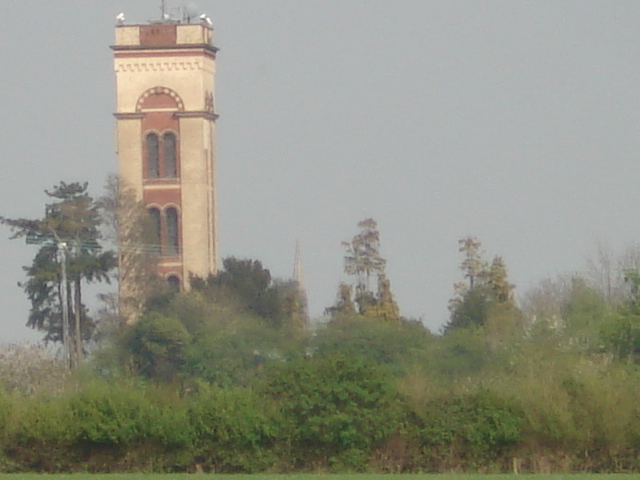
Hereford’s water tower, still I believe the tallest structure in the city, would offer unparalleled views of the area – most useful when keeping a lookout for enemy factions.

However in the 1930’s, rural areas still depended on local sources and would be largely independent of water suppies from the towns.  As is so often the case in these situations, holding the cities and towns is one thing, controlling the countryside is another…


Wednesday, 18 January 2012

Hop picking in Herefordshire


One of the fondest memories I have of my Nan is her impression of the Black Country accents she would hear during hop picking season, when people from nearby industrial areas in the Midlands and South Wales would descend into Herefordshire to earn an extra few bob.

I was also once told how my great granddad, gamekeeper Sam Jones, would occasionally be called upon by the local policeman during hop picking time to help sort out the fights that invariably broke out in the local pub when the Gypsies, who also arrived to earn some hopping money, had had a little too much to drink.

This, coupled with my dad’s memories of how surprised he was at how neat and well turned out the travelling folk were when they turned up looking for work, has always piqued my interest about how these disparate communities joined with the locals in September to meet the increased need for labour come hopping time.
My nan stands in the centre of this photo, with my dad and my uncle to her left
A search through the internet reveals a wealth of information on hop picking, and its pickers, from all corners of the UK. Rather than simply paraphrasing what has already been written, below is a collection of pertinent links, which I hope readers of this blog will enjoy perusing.

Hops and hop picking


“‘Going hopping’  for children meant sleeping on straw pallets, rabbit stews, avoiding wasps, picking hops into an old umbrella while their mothers worked at the cribs to fill the greensacks. It was a hard ‘working holiday’ but in the evening there was singing around the fires, and places to explore.”

A great source of information on the whole business of hops can be found in the website of the Bromyard Hop Festival – an organisation that celebrates everything hop-related in an annual festival. It’s fantastic that the town of Bromyard is taking the trouble to do this, and I heartily recommend that you support these guys and keep an eye out for details of the 2012 event!

The excellent Herefordshire Through Time website contains lots of fascinating articles on the world of hops, from a history of the plant to the processes involved from harvesting to drying – take a look!

The Gypsies

“One night someone rang the police to say that murder was being committed down at the Gypsies' wagons.  On arrival the police bundled the troublemakers into their vans, but as fast as they were put in at the front, they got out at the back and carried on fighting!”

I can heartily recommend the fantastic Romany Road website, which, among many other great articles, memories and photos, has a page on hop picking in Herefordshire. This includes a calendar of the hop grower’s year and a most useful article – both by Mary Horner.

Romany Road is a non-political, non-profit-making society, our aim being to share and enjoy memories and reminiscences of Romany Life, and produce a quarterly journal full of Romany stories and photographs celebrating their culture – available for a modest annual membership fee.

The Black Country


“The pickers took with them cooking utensils of every size and shape. The most important was the ‘hoppen box’. This was a tin trunk which held all the clothes.”

Check out Cradley Links, a website devoted to the history of the local and family history of the village of Cradley in the Black Country.

The page devoted to hop picking presents a fascinating collection of reminiscences of the hop picking ‘holiday’ from Cradley residents and a rather catchy song on the subject. There is also an account of when the local history group Cradley Then and Now set off in 2004 to Claston Farm in Dormington to experience hop picking for themselves.

Linking to the Bromyard hop festival mentioned above, an article in the Birmingham Post from march 2011 also harks back to the days when Midlanders would flock to the countryside to pick hops.

Wales

“Oh, it was wonderful, it was great. I used to love hop picking.”

The Jones History Website of the UK contains a great transcript of a tape recording of the reminiscences of Mr Dai Harmon, who grew up in Penyard, Merthyr Tydfil. While a fascinating insight into how life was in interwar Merthyr, it also contains a lovely snippet about the annual hop picking holiday in Herefordshire.

Further afield

Wikipedia is, as always, a useful source of information, and contains an article on ‘hopper huts’. Photos on this page led me to the website of Kent Life – Kent of course being another great hop growing area of the UK. Kent Life have recreated a collection of brick and tin hopper huts and looks well worth a visit!
Hop picking in the VBCW

The picture I have painted of Herefordshire in the Very British Civil War is of a largely isolated county where the royalist authorities struggle to contain various other factions; not least local ‘marcher lordships’, fascist organisations and rebel Anglican Leaguers.

However the hop picking season adds a whole new dimension to this, with what are essentially migrant workers pouring into the county from the Black Country, Wales and the Romany community. The commercial need to get the hops picked would undoubtedly override any security considerations that the authorities might have, and so wartime travelling restrictions would either be waived or quietly ignored by farmers and landowners.

This would open up what is essentially a local conflict – left-wing agitators from industrial and mining areas would use the hopping season as cover to infiltrate what one would assume to be traditionally poor recruiting grounds. Spreading dissent among the diaspora of hop pickers would be their goal, hopefully expanding this to the larger local population. Weapons, ammunition and equipment could also be smuggled inside sympathetic pickers’ ‘hoppen boxes’, while militant fighters themselves could masquerade as pickers.

Welsh Nationalists could also use this as a method of getting men and material into the county, albeit at the risk of clashing with left-wingers from the Welsh mining towns. This ‘fifth column’ could be used to assist their allies in the local Anglican League, or even further their wider aims of pushing out the welsh border. The tradition of churchmen preaching among the hop pickers could also serve as a useful recruitment tool for the Anglican League.

The Romany community largely kept themselves to themselves, and might be less susceptible to such agitation. However at a time when life was no doubt more difficult, arms were plentiful and suspicion was rife, the sadly still current mistrust of travelling folk could escalate into something more deadly, leading Gypsy families to take the necessary steps to protect themselves, especially in areas where far-right groups have the upper hand.

What was once seen as a family holiday and a chance to earn some extra cash could well develop into a deadly battle among the hop yards, hopper huts and drying kilns.