Friday, 19 August 2011

Interwar aeronautics in Herefordshire

I recently came upon a great website that contained PDF copies of every publication of 'Flight' magazine from 1906 to 2005. A quick search revealed some interesting facts about Herefordshire, including the campaign for an airport, the Three Counties race and the role of Painter Brothers in aeronautical manufacturing.


Even in those days, politicians would go to any lengths to canvas for votes, as is evidenced by this piece in the September 9, 1920 edition of Flight:
“During the War Mr. Geoffrey Le M. Mandes was in the Royal Flying Corps. He is now utilising his skill then acquired, in his campaign as prospective Liberal candidate for North Hereford Division. This week he was responsible for a flying exhibition, a feature at Leominster Agricultural Show.”

In April 8, 1926, it was reported that: “MRS. ELIOTT-LYNN, the energetic lady member of the London Aeroplane Club, made a successful parachute drop from an aeroplane at Hereford on April 3. When attempting this feat the day previous, the machine carrying her developed engine trouble just as she was about to jump, and had to make a forced landing, with Mrs. Eliott-Lynn still clinging to the side of the aeroplane.”

As reported on September 20, 1928, the Isle of Purbeck Light Aeroplane club came to the aid of the agricultural sector:
"Club work has been somewhat curtailed this week, owing to the fact that the Spartan, living up to her name, became restless on hearing about the milk war. Feeling it was necessary to soothe her and assist our firm friends the farmers, we offered her services to Alderman E. W. Langford, Mayor of Hereford and Chairman of the National Farmers' Union Milk Committee, who has since been airing his views and himself in almost every milk-producing area in the country, from Wiltshire to Northamptonshire, and incidentally we believe controlling the Spartan as well as the milk war."

Politics came to the fore again in 1929, as shown by an article in the May 30 edition entitled ‘Touring Constituencies by Light ‘plane’: “Capt. H. M. Yeatman flew his own Cirrus-Moth to help Maj. F. M. Dougall contest Hereford in the Liberal interest. Maj. F. M. Dougall is on the staff of the Daily Express.”

Hereford Aerodrome

The December 13, 1928 edition of Flight reports on the efforts of a number of towns in getting a municipal aerodrome:
“Hereford's possibilities as an air station for traffic flying between the North of England and South Wales and the West country were discussed by the Hereford Chamber of Commerce recently. The Chairman, Mr. G. W. Russell, said it behoved Hereford to be in the van, and see that the claims of the city were furthered. Mr. Storr-Barber said that it would be of great advantage to the city to become an air station, and it might be that the promotion of such an establishment might lead to the coming of a factory. The Chairman then proposed that they inquire what steps other towns were taking, and then do something direct. It is stated that there are many places in the vicinity that could be adapted to the purpose.”

 In the April 18, 1929 edition, Hereford is listed as one of the towns ‘which have sites in view’. A couple of years later and things have moved on a little with the establishment of the Hereford Aeroplane Club:
“Progress in establishing a municipal aerodrome at Hereford has not been very evident for some time, but now that there is a movement on foot to establish the Hereford Aeroplane Club. We trust that this latter may be the means of making the authorities wake up to the value of having their own aerodrome. The Lord-Lieutenant, Sir John Cotterill, Bart., has consented to become patron to the club. The subscription has been fixed at £3 3s. for pilot members, /2 2s. for ordinary members who are entitled to fly only as passengers, and 10s. 6d. for junior members. A committee has been formed, and Mr. P. Gwynne James, of Marston House, Belmont Road, Hereford, will be glad to furnish further particulars to anyone in the district who is interested.”
 In May 22, 1931, Hereford is listed as one of the towns where ‘complete surveys of the environs’ had been made.

However, the December 7, 1933 issue reveals little change in the situation. In an article entitled “THE POSITION TO-DAY - A Guide to the Municipal Airport facilities offered by the sixteen established Airports”, Hereford is listed as one of the ‘towns which have had sites inspected’. Optimism must have still been high however, for in April 5, 1934, it was reported that “At a meeting of the Hereford Council recently, a ten minute air service between Hereford, Gloucester and Worcester was forecast.”

By 1936 it seemed like an airport at Hereford was on the cards, situated by the racecourse. The site had already witnessed the Three Counties Air Race (see below) and the opening paragraph of a report on that event in September 24’s issue stated:

“After seven years of endeavour by a few interested Hereford people, notably Mr. W. Shimmins, the engineer and surveyor, it would appear that the city may have its own airport within the next twelve months. Purchases have been made and options obtained on quite a lot of land beside the existing racecourse, and the fact that, even now, the teeshaped site is usable was shown last Friday, though, on first sight, the runs appeared to be inadequate when the boundary obstructions were taken into consideration.”

What better way to christen the airport, then to hold a thrilling air race!


The Three Counties Air Race of 1936

Flight’s August 20th, 1936 edition contained an article entitled ‘Hereford comes in’, in which it was announced that:
“On September 18 and 19 a flying meeting and handicap air race over three laps of a triangular course between Hereford, Gloucester and Worcester, is being organised. A cash prize of £50 and the Hereford City Trophy goes to the winner, with two other trophies and £30 and £15 for the second and third finishers. The pilot making fastest time, the first lady finisher and the first pilot flying a machine with an all-up height of less than 8oolb. to finish will each be awarded a trophy. The race will start at 11 a.m. on Saturday, September 19 and all normal entries must be in by first post on September 12; late entries at double fees can arrive by first post on September 18.
The "base camp" will be the old racecourse at Hereford, which is being cleared by the city council, and will be officially recognised by the Air Ministry as a landing ground; the runs are about 800 yards, in each direction.
Unfortunately, the organisers have not noticed that the London-Cardiff race is due to be held on the same date, and, as this is something of a classic, it is likely to take all the entries. Perhaps the Hereford show can still, in the circumstances, be dated back a week.
Pilots and manufacturers who are interested should write to Mr. J. Buckley, c/o Thome's, Ltd., Commercial Road, Hereford. The organisers are Western Aircraft Sales, Ltd., 18, The Butts, Worcester.”
Concern over clashes with the London-Cardiff race must have indeed caused problems as the Hereford race was later brought forward a day to the Friday, starting at 3pm.

The September 24 issue chronicled the great race. See above for the opening paragraph of the article, which then continues:
“For the Three Counties Air Race there was certainly an extraordinarily good entry, some score of machines appearing on the line for the start, including one or two of those owned by our better-known racing pilots, and such larger types as a Monospar S.T. 25, flown by Mr. Seth-Smith, and a D.H. Dragonfly, flown by Mr. S. F. Woods for Mr. S. Harris. Every machine got off with plenty of room to spare and the only unpleasant moment occurred when a certain very experienced pilot carried away a few telephone wires on his arrival. Although roomy enough, the ground was a trifle rough at the end of the run and the most interesting sight of the afternoon was that provided by a score of pilots vying with each other in the work of making the shortest possible landing over obstructions. Some of these were incredibly short and showed what could be done—with care.
The whole affair was run on most informal lines. The course consisted of three laps of a not-too easy thirty-mile circuit, and the pilots were handicapped on their own estimated speeds, anyone exceeding this speed being disqualified. The Rev. Cecil Boulton (Spartan) was the limit man and W. Humble (Hawk Six) was on scratch.
Even after the first lap the placings had obviously altered considerably, though it was difficult to follow the race. After two laps all manner of things had occurred. R. F. Hall (Avro Cadet) had worked up from eleventh place, through ninth place, to the lead; the. Misses Glass (D.H. Moth) had moved from fourth to second; and the Spartan was flying fourth. Humble was not yet in the picture, though he had picked up two or three places, the Monospar was running twelfth after starting in fifteenth position, and S. T. Lowe (Comper Swift) had moved from sixteenth to eleventh.
The finishing order of the leaders was as follows: 1, R. F. Hall (Avro Cadet), 45 min. 34 sec.; 2, Miss Mabel Glass (D.H. Moth), 48 min. 0 sec.; 3, A. F. E. Payen (D.H. Puss Moth), 45 min. 14 s e c ; 4, P. D. Hayn (D.H. Moth) and S. T. Lowe (Comper Swift) ; 5, C. H. Tutt (D. H. Moth) ; 6, K. G. Seth-Smith (Monospar).
Thereafter, pilots and others adjourned for further informal proceedings at the City Arms Hotel.”


After the race, some participants hoped to race in the London (Heston)-Cardiff event. However: “the Misses Glass could not get through to start after the Hereford event; they came on to Cardiff in time to see the finish after putting down at Cheltenham. Humble and Napier got through from Hereford to Heston by the skin of their teeth and by virtue of the latter's intimate knowledge of the Great Western Railway”

Last word should perhaps go to the author of ‘Topics of the Day’ in the same issue, who had a thing or two to say about ‘safety first’. While warning readers that ‘you cannot play the fool with an aeroplane’, he also wrote:
“Motor racing and air racing are only good because the competitors are pitting their skill against those risks, and I consider, for instance, that the two competitors in the Hereford race, who were also flying in the Cardiff event, were fully justified in taking some chances in getting back to Heston for the second race when the weather was really too bad for cross-country work without radio. Equally justified were the other less experienced competitors who put down on the way to Heston and ‘gave in.’”
The Airfields of Britain Conservation Trust lists the racecourse airport as operational between 17 September 1936 - 1952, with another airfield near what is now Wyvale between 10 September 1921 - September 1939.

Aeronautics manufacturing and other businesses in Herefordshire

In March 11, 1932, it was announced that with the exception of business with the Air Ministry and the Royal Household, the whole of De Havllland aircraft sales in England would be handled by three concerns, and they in turn would be responsible for the organisation of sales throughout their own particular areas.

Herefordshire came under the aegis of Phillips & Powis Aircraft (Reading), Ltd. Who were responsible for the Counties of Buckingham, Berkshire, Oxford, Northampton, Warwick, Leicester, Rutland, Worcester, Gloucester, Stafford, Shropshire, Hereford, Monmouth, Glamorgan, and Somerset, north of the Railway Line connecting Clevedon, Axbridge, Wells, Shepton Mallet and Frome.

One of the new companies listed in June 18, 1936 was Western Aircraft Sales, Ltd: “Private company, registered June 10. Capital, £1,000 in £1 shares. Objects : to carry on the business of manufacturers
of and dealers in aeroplanes, airships, etc. The permanent directors are : 'Robt. White, "Crahmond," Hampton Park, Hereford (director of H. B. Rogers Motors, Ltd.); Edward R. Exell, Greenacres, Bobblestock, Hereford .”

In the June 25, 1936 edition, an advertisement for the Midland Gliding Club Ltd of Birmingham invited readers to ‘Learn to fly without an engine and make pleasure of it.’ Primary grounds were listed as Handsworth, Northfield and Hereford, with a Soaring Centre at Long Mynd and Church Stretton.

Mr. White appeared again in April 29, 1937 under another local company - Aeroparts Engineering Company Ltd: “Private company, registered April 25. Capital, £3,000 in 3,000 shares of £1. Objects : to carry on the business of aircraft constructers and builders and type-testers of engines and aeroplanes, etc. The directors are: Hugh K. Pierson, Cyril H. Shelton, Robert White. Solicitor: Frank T. Carver, 44, Bridge Street, Hereford.”

This company advertised in the Situations Vacant section in July 8, 1937: Inspector for detail parts, with workshop or drawing-office experience. Aeroparts Engineering Co. Ltd., Phoenix Works, Hereford.

Painter Brothers

Painter Brothers, founded at Hereford in 1920 and incorporated in 1929, is a major British fabricator of structural steelwork and one of the leading producers of bolted lattice steelwork in the world. 
In the March 11, 1937 issue, notice was given of Painter Brothers’ heavy-duty storage bins:
“Giving details of their new system of unit-construction storage bins, a booklet has been issued by Painter Bros. Ltd., of Hereford, and of 60, Hillmarton Road, Caledonian Road, London, N.7.
The bins, made of heavy-duty British mild steel, galvanised with pure zinc, give 18 cu. ft. of storage space, or 16 cwt., in each compartment.
They are constructed on the multiple unit principle, in standard four-high units, for either single wall or back-to-back storage. Both types can be supplied with either open or closed backs.”

The company (in conjunction with Callender's Cable and Construction Co Ltd.) provided the steelwork for the first Callender-Hamilton unit-construction hangars ordered by the British Air Ministry in the pre-World War II rearmament programme. An article to this effect appeared in the January 20, 1938 edition:
“The Air Ministry has had eight of the Callender-Hamilton unit-construction hangars erected on various sites, and the necessary steelwork is now available on a commercial basis. The famous cable and pylon firm have placed the hangar on the market in conjunction with Painter Bros., Ltd., of Hereford, after exhaustive tests.
Some of the claims are: Lightness with low cost, standardisation of parts, ease of transport and erection, all connections by bolts, and all parts protected against corrosion by special hot-dip galvanising (as used on " grid " towers) after fabrication. The sliding doors system incorporated gives maximum clear opening, the foundations may or may not be set in concrete, and the roof, sides and doors can be covered with any form of material.
The steel framework consists of a series of box girder ribs comprising vertical stanchions supporting flat pitch roof girders of similar cross section. These girders give normal clear height of 25 feet on a span approximately 10a feet. Any* length of hangar may, of course, be built by adding bays as required. The manufacturers, Painter Bros:, are specialists in the fabrication and galvanising of light steel structures.”

Munitions

With a possible war looming, Flight issue January 7, 1937, had this to report:
“Westward Ho! The explosives departments of Woolwich Arsenal are shortly to be moved to new arsenals at or near Chorley (Lancashire), Bridgend (Glamorgan), Irvine (Ayrshire), and Hereford. Some superficial thinkers have been writing in the papers that as the increasing endurance of aeroplanes will soon put all parts of the British Isles within the range of a Continental enemy, there is no great advantage in moving westward.
Such a view overlooks the fact that the passage of raiders across England, even for half an hour, very greatly increases the chances of the defence. The course of the raiders can be followed and plotted, and time is given for guns and fighter aeroplanes to get ready for them.”

I assume by ‘Hereford’ the article is referring to ROF Rotherwas, which is another story altogether…

Wednesday, 17 August 2011

The Archenfield Amateur Athletics Association

Athletic support for the Anglican League!

After finishing my Blackshorts I had a few (mainly short-wearing) figures left over in the lead pile, so I thought I'd do a sporting-based unit for the Anglican League.


And, true to form, I wrote a short history for the GWP...

You may remember, before the war, how a plucky band of provincial sportsmen hit the headlines.

Who could forget the stirring story of the dashing Indian Army officer who returned to Blighty to inherit a fortune, or how this fellow – a deeply religious man who believed that a healthy body equalled a healthy soul – settled near Ross-on-Wye and formed a cadre of fit young men from the ranks of the listless unemployed in the area?

Surely you haven’t forgotten the stirring tale of how the Archenfield Amateur Athletic Association took on all-comers and beat them into a cocked hat? How about that infamous time when the AAAA reached the finals of the All-England Athletics Championship and tied with the nation’s top clubs at the top of the medals table?

And what of that dreadful moment when, in the 100 metres dash – the final edge-of-your-seat event in the competition – AAAA sprinter ‘Flash’ Harry Davis sprawled off the track after being allegedly elbowed aside by that bounder from the Borehamwood Blackshirts, costing the underdogs the trophy? And how about when the King himself, officiating as honorary umpire, refused to listen to their complaints and labelled them as ‘sore losers who should go back to their sheep or whatever’?

Well now they’re back in the limelight. Track and field has been replaced by callisthenics and rifle practice as the Archenfield Amateur Athletics Association once more take to the arena in a far deadlier competition.

The Blackshorts

One of my favorite television shows is the TV adaptation of PG Wodehouse's Jeeves and Wooster stories, starring Hugh Laurie and Stephen Fry. One of the recurring 'villains' in the show is Roderick Spode and his Blackshorts (a pastiche on Mosley and the Blackshirts).


Naturally the Blackshorts were the first thing that sprung to mind when I thought about creating my own VBCW force. All I had to do was find some suitable short-wearing miniatures, and work the organisation into my interpretation of Herefordshire.

So first, the miniatures...

The whole battalion.

Command group (L-R: Medic, Batman, CiC - Eustace Spode, Standard Bearer, Political Officer - 'Trouncer' Trudd, Sniper, Signaller).

A Coy. The Marches Blackshorts.

B Coy. The Metropolitan Blackshorts.

HMG team.

Boys anti-tank rifle team.

Secondly, the backstory (as seen on the GWP)...

The Blackshorts and Herefordshire: a short history

Roderick Spode and the Blackshorts


"The trouble with you, Spode, is that just because you have succeeded in inducing a handful of half-wits to disfigure the London scene by going about in black shorts, you think you're someone. You hear them shouting "Heil Spode!" and you imagine it is the Voice of the People. That is where you make your bloomer. What the Voice of the People is saying is: "Look at that frightful ass Spode swanking about in footer bags! Did you ever in your puff see such a perfect perisher?"

Before the civil war, the Blackshort movement was just another crack-pot pseudo fascist paramilitary organisation. It was founded by the 7th Earl of Sidcup Roderick Spode – amateur dictator, proprietor of Eulalie Soeurs underwear emporium, jewellery expert, designer of the collapsible channel bridge and a man appearing "as if Nature had intended to make a gorilla, and had changed its mind at the last moment."

The Blackshorts espoused a philosophy similar to many other right-wing groups: protectionism, rationalisation and the ‘scientific’ categorisation of the British populace. For Spode, this meant banning the import of foreign root vegetables and instead encouraging every free-born Englishman to grow his own potatoes, while giving over entire counties for the cultivation of a single crop (turnips for Gloucester, beans for Wiltshire, Wales and Scotland nothing but potatoes.)

He also planned to ensure that every citizen owned a British umbrella and an ‘honest, British-made bicycle’ (to be manufactured solely in Norfolk, along with motorcars), thus ensuring a mobile workforce adequately protected against the elements. While many groups would grade this workforce by race or class, for Spode and the Blackshorts the only feature worth measuring was the knee.

The Blackshorts and the civil war

"The British knee is firm, the British knee is muscular, the British knee is on the march!"

When King Edward VIII installed British Union of Fascists leader Oswald Mosley as Prime Minister and the flames of civil war began to break out across the country, once-derided organisations such as the Blackshorts took on an air of legitimacy.

For many people, anxious to ‘get on’ under the new regime, the prospect of joining a uniformed paramilitary group less sinister than the BUF was an attractive one. Recruits flocked to the smaller, more ‘harmless’ groups such as the Blackshorts, hoping to gain the kudos of wearing a right-wing uniform without the onerous duty of having to fight or hail Mosley as leader. The Blackshort organisation grew, much to the alarm of Mosley – jealously guarding his influence and determined to stamp out any independent movements in the metropolis.

Soon other smaller groups were being disbanded or absorbed into the BUF, but with the Blackshorts Mosley had a problem: Eulalie Soeurs had become a favourite haunt of many influential women, including none other than the Royal Consort, Queen Wallace. Moving against Spode was to move against Eulalie’s ‘Royal Appointment’. The only option was to move the Blackshorts away from London and post their armed militia to distant parts of the country.

Eustace Spode and Herefordshire

“When one can no longer approach a chap in a gentleman’s convenience to inquire after the time, without being roughly apprehended by a plain-clothes policeman – well it’s a bally nuisance!”

Spode was reluctant to relocate from the capital lest distance diminish his business and political clout, but found himself under severe pressure from the government to conform to Mosley’s will. Luckily, a solution was soon discovered, for out in the depths of rural Herefordshire a smaller Blackshort group was being formed under the aegis of Lord Sidcup’s nephew, Eustace Spode.

Eustace had been exiled after an unfortunate misunderstanding that had not only left a stain on his character, but also the Spode name. Under instruction to form a branch of Eulalie Soeurs in Herefordshire, Spode the younger was desperate to worm his way back into his uncle’s good books and as such began to form an embryonic Blackshort cadre from his circle of friends and any sympathetic locals who, like their London brethren, hoped to further themselves by joining a right-wing force.

Organisationally, Eustace’s Blackshorts were part of the royalist King Offa’s Legion alongside the BUF. Tasked with securing the border against Welsh nationalist incursions, King Offa’s Legion suffered from a crippling lack of manpower. Under pressure from action by the Anglican League and the Malvern Hills Conservators, the BUF elements of the Legion were reorganised into the Three Counties Legion, leaving Eustace Spode in sole charge of King Offa’s Legion.

This situation presented both Mosley and Spode with an ideal compromise: Spode could continue to finance his Blackshorts, provided they were sent to the provinces to reinforce existing royalist units. Thus Eustace found himself not only in command of his original ‘Marches Blackshorts’ company, but also a full company of more well-equipped but less experienced ‘Metropolitan Blackshorts’, complete with heavy support weapons, paid for by Lord Sidcup.

March of the Blackshorts

"Nothing stands between us and our victory except defeat!"

And so the forces of fascism had a new champion in the barbaric backwaters of the west of England - King Offa’s Blackshort Auxiliary Legion. Standing firm along the Anglo-Welsh border, the sturdy-kneed Blackshorts of Herefordshire were ready to fight the grubby, knock-kneed Welshman; the thin, knobbly kneed Bolshevik and the fat, puffy-kneed Anglican in the name of the true King, Edward VIII, his royal spouse and purveyors of top-quality ladies’ undergarments everywhere!

Tuesday, 16 August 2011

Generic militia - Dixon minis conversions

My first real crack at converting miniatures. I had a few old Dixon ACW minis knocking around, so I thought I'd try converting them into a generic VBCW militia.

I bought some extra Dixon French resistance fighters and, thanks to some weapons, helmets and equipment from The Assault Group (and a couple of Milliput flat caps), came up with this...


This unit doubles up as either an AL militia or a royalist mercenary group (The Monmouthshire English Trained Band).

Monday, 15 August 2011

Twiggy Mommet scarecrow protestors

My rural protestors!


Figures are a mix of Gripping Beast, Rapier minis, Brigade Games western bushwackers, Brigade Games Russian Ghouls (with milliput heads), Black Cat Bases and Heroclix.

Thursday, 11 August 2011

Some useful theses available on the web

During my sporadic research I've come across a few useful theses whilst browsing the web...

The Management of Road Traffic in a Rural County

This thesis concentrates on the interwar period in Herefordshire. While it obviously concentrates on road and transport issues, it also provides some interesting background information (including a useful population density map, and a map of the principle roads throughout the county).

The British Union of Fascists in the Midlands, 1932 – 1940

An interesting study of the BUF in the Midlands. It doesn't mention Herefordshire, but is still useful background reading as the Midlands isn't a million miles away.

Able Bodies: Work camps and the training of the unemployed in Britain before 1939

A study of Britain's instructional camps, where the long-term unemployed were given manual labour in order to 'harden them up'. There was an instructional camp near Shobdon in Herefordshire.

An Uneasy Alliance? Welsh Nationalism and Roman Catholicism

Interesting reading given that, in the VBCW universe, Welsh nationalists are operating along Herefordshire's western flank.

Wednesday, 10 August 2011

The Battle of Much Marcle

The Anglican League make a push on Ledbury - an excuse for me to disappear during the royal wedding last April! Another write-up from the GWP...

The Anglican League enclave in Ross, Herefordshire, is in trouble.

Under the command of a firebrand Welsh vicar, the Reverend Henry Meredith, Anglican forces in the area have being slowly building up strength, but have yet to formulate a clear future strategy.

They are also in a rather unhappy marriage with the Welsh nationalists – a hangover from the Bishop of Hereford days. The Welsh are becoming more and more unpopular with the locals around Ross, where the heady days of revolution have begun to revert back to a conservative, anti-Welsh, traditionalism. As a result of this, Meredith and non-local units under his control are beginning to be viewed with suspicion, with many openly questioning his suitability for leadership.

To make matters worse, supplies are dwindling. Arms and ammunition from Monmouth are becoming a rarity as the difficult route from North Wales, down the border to Monmouthshire, is increasingly disrupted by royalist patrols of the Legion of King Offa in Herefordshire. There is also the suspicion that the Welsh are funnelling most of their supplies to the more lucrative market in Shropshire.

The alliance with the nationalists has also put paid to any co-operation with coal mining leftists in the Welsh valleys – who are at any rate squaring off with the Mayor of Cardiff, while the less reliable assistance of radicals in the Forest of Dean to the south has also dwindled as they prepare their defences against the Duke of Montfort in Gloucestershire who is determined to snuff out their banditry.

In short, Meredith needs new allies, and as such, puts his faith in God – who does not disappoint.

For across the border in Worcestershire, the Malvern Hills Conservators have scored a decisive victory against the hated BUF at Drugger's End, near Castlemorton. The Malverns, and nearby Ledbury, have a tradition of anti-fascist leanings – from the Twiggy Mommet movement to this recent battle, the area is ripe for an Anglican rebellion. It is only natural that Meredith and the MHC should join hands at Ledbury.

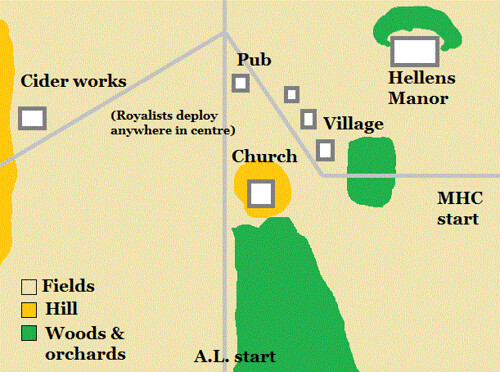
A plan is formed. For the Anglican League to take Ledbury they must first occupy the village of Much Marcle on the Ross-Ledbury road. Here lies the only significant obstacle to an eastward advance – Hellens Manor and the local royalist LDV, the Much Marcle Wanderers. If this threat can be neutralised, a message will be sent to other local landowners, upon whose support the thinly-stretched BUF (in the shape of the Three Counties Legion) rely heavily.

Once Much Marcle falls, Meredith hopes, the citizens of Ledbury will rise up in support of the League and he will be able to link up with not only the MHC, but the Severn Riverside, Wharf, Labours, Federation (SRWLF) in the Diglis canal basin and the remnants of the larger AL forces who are lurking somewhere south of the Malverns following the Severn Valley campaign. With these forces united, a push towards the King’s residence at Madresfield and/or the occupation of Worcester could well be the next step.

It’s a huge gamble, for word travels fast in Herefordshire and the royalists will be quick to respond to any attack, but the possible gains are immense. And so the Anglican League head east, while the MHC head south, skirting Ledbury to reach Much Marcle via Dymock. The scene is set – will the Anglican League turn the tide, or will the BUF get their revenge against the Conservators? Once again gunshots will ring out in the shadow of the Malverns.

Once again I'm going to quote Giles for an after action report...

JP and I had a really good game today.

The Anglican league were attempting to push eastwards towards the Malverns, and the Malvern Hills Conservators (MHC) though nominally Royalist were looking for support ion their spat with the BUF. Obviously the BUF were keen to stop this link up.

The village of Much Marcle was the centerpiece,with Westons' cider factory as an objective the BUF dug in and the Anglicans started their attack...only they didn't because JP pulled a random event card that destroyed his communications.

The next two rounds were spent in desultory fire, the BUF's tank fired ineffectually at the armoured car of the Anglicans. The Anglicans lost an HMG and half a unit, whilst destroying the BUF tank

Then the MHC arrived. JP pulled a car from the random events that showed the MHC and BUF were deadly enemies, both sides charged towards each other recklessly. Their armoured car careered through a fence to engage with the elite BUF unit. Ther two sides engaged in hand to hand combat

The MHC wiped out one BUF unit, but the BUF wiped out their command unit and captured the MHC's commander seeing off a second unit. The MHC with their HMG already suppressed ran for it.

Result: The BUF defended their position. The Anglicans have a toe hold in Much Marcle and the MHC have been repulsed.

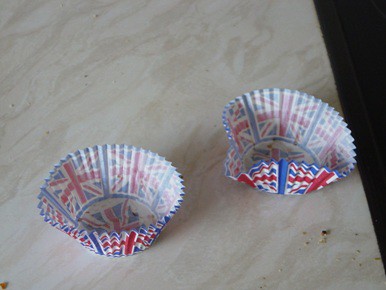
We also had (royal wedding) cup cakes from JP's wife.

First, a little light refreshment...

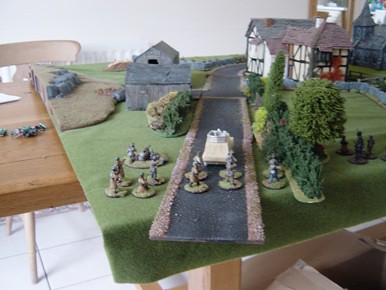
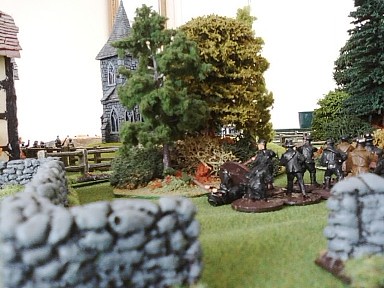
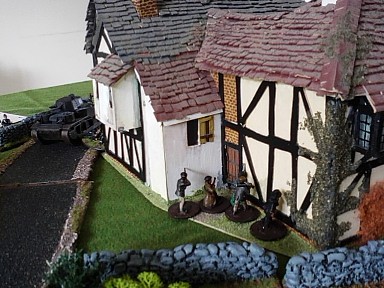
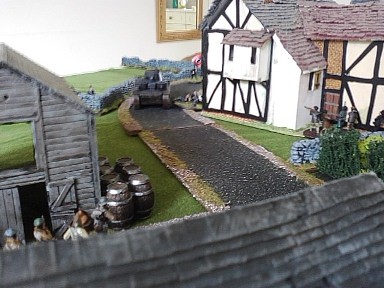
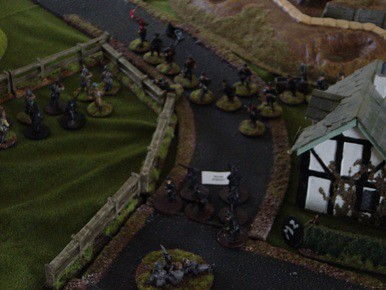
The village of Much Marcle. The Anglican League's entry point is bottom left. The BUF have defensive positions at the top end, while the MHC arrive at the right hand side.

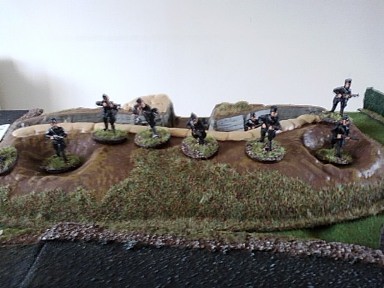
The BUF dig in and await the enemy

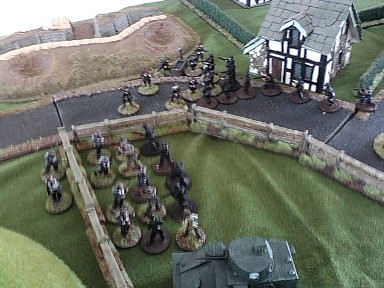
The Anglican League advance towards the village (eventually)

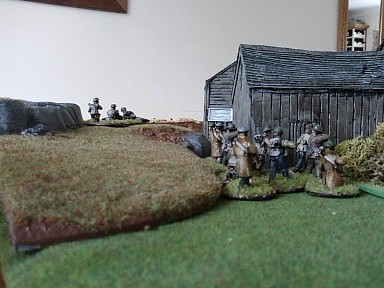
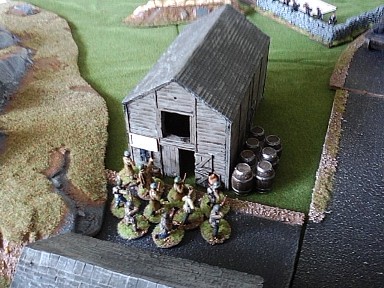
The AL's let flank skirt the cider factory...

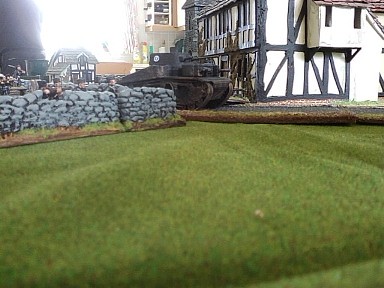
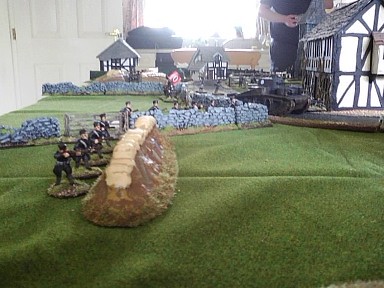
...To avoid fire from the BUF's tank and MMG

The AL advance under fire towards the church in the centre

The MHC arrive!

The AL occupy the pub - cheers!

And also the cider works - cheers again!

Deprived of a drink, the BUF right flank pour fire at them from their defence works

But on their left, they spot their hated foe and, desperate for revenge, leave their trenches and charge!

An almighty scrap ensues between the Buf and MHC

On the other side, the AL and BUF exchange fire

The BUF tank is knodked out by the AL's battered armoured car

By the church, the MHC and their armour get the better of the BUF

But the MHC's command decide enough is enough after being battered by their mortal foe!

Yum!