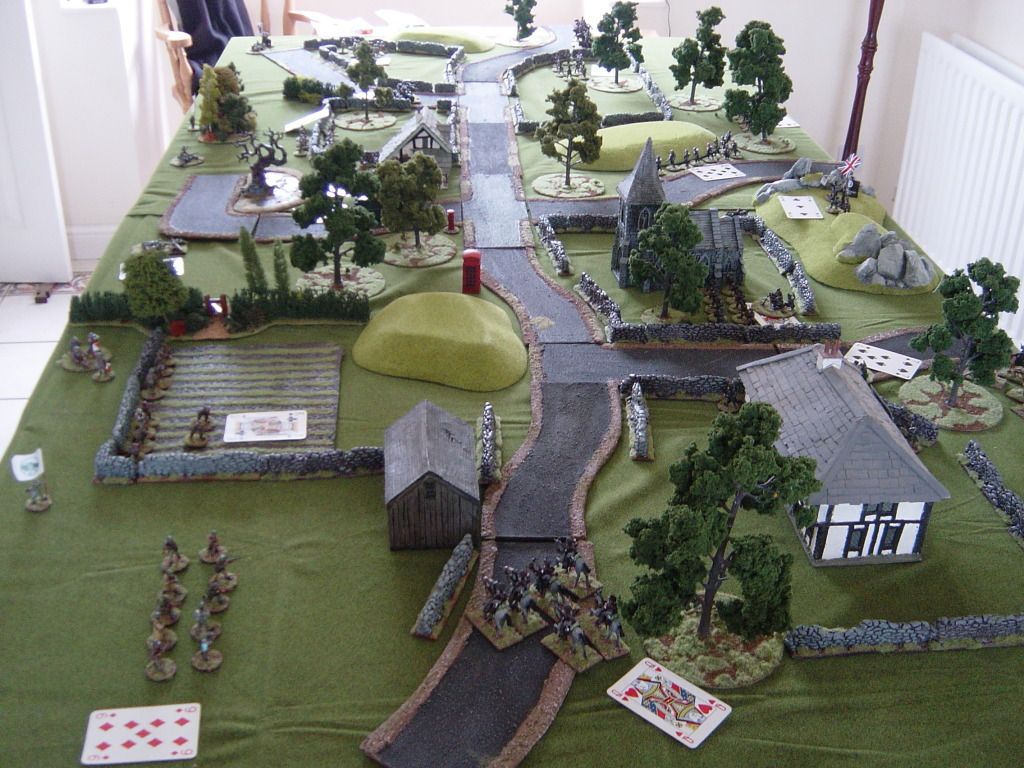
In thanks for helping to organise the Ledbury game (and despite my no-show!), one of the players very kindly left two scarecrow figures (pictured in the foreground below) he had made for me (thanks Tym!)
This prompted me to dig out a short 'history' of the Twiggy Mommet protest movement that I wrote a while back...
Twiggy Mommet - A Very British Protest Movement
Introduction
From the peasant revolts of the Middle Ages and the Clubmen of the English Civil War to the post-1918 anti-tithe campaigns, the tradition of British agrarian protest movements goes back centuries. In times of economic hardship, even the smallest incident could cause the usually powerless and docile rural masses to rise up against a perceived injustice.
Such riots were as apolitical as they were damaging: angry mobs or individuals would resort to acts of vandalism, arson or intimidation to achieve their aims. However, while lives were sometimes lost, protest movements seldom sought armed insurrection or the overthrow of government and were usually quelled in a short period of time.
More often than not, disturbances centred on the supposed leadership of a semi-mythical character, affording rioters a degree on anonymity. 'Captain Rock' caused havoc in Ireland in the 1820s, a decade later 'Captain Swing' attacked new-fangled threshing machines in Southern England and a short while later 'Rebecca' led cross-dressing Welshmen against the hated toll gates. It was also not unusual for such characters to appear in different parts of the country, adopted by other groups as the template was copied and adjusted to suit local conditions.
In the 1930s times were tough for agricultural communities. After the Great War economic conditions had forced many big landowners to sell farmland to their tenants. Within years these new farmers, often obliged to purchase lest they lose the home that they had inhabited for generations, found themselves with huge mortgages for land which had rapidly reduced in value. They also had to contend with falling prices for their produce following the National Government's reluctance to impose tariffs on foodstuffs and the imposition of tithe payments: 'Queen Anne's Bounty.'
It is not surprising then that the outbreak of the 1938 British Civil War, and the resultant chaos that engulfed the country, saw the birth of yet another rural protest movement. What is unusual is that this movement, although keenly supported by impoverished farmers and agricultural workers, was actually sparked by the arrest of a middle-class teacher from the small market town of Ledbury.
Origins
Herefordshire, once a centre of Anglican resistance against Edward VIII's government, had only been under Royalist rule for a few weeks when Tom Corbin, a popular local primary school teacher and keen market gardener, placed a scarecrow wearing a BUF armband in his Ledbury allotment in protest at the new authorities' levy on the sale of foodstuffs.
Keen to stamp out any signs of dissent, the governor of Hereford sent a BUF patrol to investigate. Corbin was duly arrested, his goods confiscated and his scarecrow publicly burned in the centre of town. Confident that this malcontent had been made an example of, the patrol withdrew back to their barracks in Bromyard.
However a few nights later, a strange mob marched down Ledbury high street. Dressed in old clothes, their hands covered with rags and their faces with hop sacks, they broke into the local gaol, bound the constable on duty and demanded the release of Mr. Corbin from captivity. Upon hearing that he had already been let off with a caution, they contended themselves with tearing up any official papers they could find, before making a hasty exit at the approach of police reinforcements.
A note pinned on the door of the gaol, addressed to the governor from 'Twiggy Mommet, King of the Scarecrows', stated that the attack was in retribution for the 'unlawful murder by fire of one of my subjects in the once happy town of Ledbury.'
Soon other scarecrows were cropping up around the county, not only in the fields and gardens of defiant Anglican supporters but also, under cover of darkness, the estates of leading royalists. Some bore BUF insignia, while others were made up in effigy of the King or his new wife. Many of them wore pieces of clothing previously stolen or snatched from BUF members, such as sidecaps and armbands. The authorities duly removed and destroyed these mannequins, which in turn led to further disturbances by 'scarecrow' mobs, wielding various agricultural implements, in revenge for these 'killings of our straw brethren'.
Determined to nip this embryonic rural protest movement in the bud, the BUF laid a trap by arresting a well-known local postmistress, one Ms. Prudence Powell, after secretly erecting their own scarecrow in her garden. Sure enough, while the BUF lay in wait, Twiggy Mommet's subjects came out to free the stricken damsel. This time however, no doubt due to some well-placed local informants, they had swapped their pitchforks and scythes for rifles and shotguns.
Blood was spilled and lives were lost, but Twiggy Mommet's scarecrow army marched on, leaving their gardens, allotments and fields to protect any Herefordian wronged by the authorities. Rural (an increasingly suburban) Britain had found its protector and soon 'The Ballad of Twiggy Mommet' could be heard being crooned in pubs throughout the country.
Twiggy Mommet nationally
As news of the Herefordshire disturbances spread, other communities adopted the Twiggy Mommet theme as a way of expressing their dissatisfaction with their leaders, irrespective of political and factional leanings. In royalist country fascist 'bully boy' paramilitaries were often the target of the scarecrows. Anglican League areas saw outbreaks of 'Mommetism' whenever church officials imposed heavy-handed tithes on their parishioners. Socialist enclaves also saw disturbances, as the more conservative-minded comrades baulked at the sudden overthrow of the old order and the redistribution of wealth and land.
The movement was slower to take root in nationalist areas like Scotland, North Wales and Cornwall, where Twiggy Mommet was seen as an 'English' innovation. Nonetheless, incidents occurred occasionally, usually in border areas where enthusiasm for nationalism was at its weakest. For example in nationalist Wales, the counties of Monmouthshire, Brecknock and Radnorshire with their mixed Anglo-Welsh population and their proximity to Herefordshire, saw more than their fair share of incidents.
Naturally this mainly agrarian phenomenon was also less prolific in urban areas. However reports of libellously dressed scarecrows being discovered in allotments and gardens occasionally led to lurid stories of strange and ancient countryside rituals seeping into civilised society in the more excitable newspapers. It was also not unknown for anti-government supporters in some of the bigger royalist cities to discreetly place a tiny model scarecrow in their window box as a small gesture of defiance.
In some parts of the country, criminal gangs and bandits also made use of the scarecrow motif, using the movement as a cover for their nefarious activities. In other, mainly royalist, parts of the country, small counter-movements sprang up as young, mainly well-to-do men took to dressing up as scarecrows for retaliatory attacks on suspected Twiggy Mommet agitators. The first recorded instance of this is the 'Royal Order of the Knights of the Pumpkin Patch', created in response to the appearance of a scarecrow in the grounds of Shortwood Manor, Buckinghamshire.
Organisation and tactics
The Twiggy Mommet protest movement had no official hierarchy or indeed chain of command. Usually bands of protestors would gather spontaneously under the nominal banner of King Twiggy, usually represented in practical terms by a particularly respected or forceful local, following some incident or insult.
While some individuals remained hardcore supporters of the movement, most protestors were ordinary citizens, stirred into desperate action by a hated official, policy or a host of other reasons. As such bands ranged from a handful of individuals to a huge mob depending on the scale of the protest.
Tactics were also practically non-existent, although a rough plan of action may have been agreed upon in a pub or farmhouse beforehand. Usually the protestors would resort to nocturnal acts of vandalism, more often than not the simple act of planting of a scarecrow. Gaol breaks, acts of arson or the roughing up of a target might also occur occasionally.
These largely bloodless affairs would sometimes degenerate into fighting, especially if the perpetrators were caught in the act. Retaliatory measures would lead to revenge attacks, but while the cycle of violence often escalated into skirmishes and ambushes, Twiggy Mommet protestors seldom took to the field in set-piece battles unless their cause was particularly strong.
On such occasions protestors would attempt to remain under cover for as long as possible, preferring to stalk the enemy and launch a surprise, close-range attack. Defensive actions rarely lasted for long, as the protestors would begin to melt away if casualties were taken. However it was not unusual for them to reorganise and re-take to the battlefield if conditions were thought to be favourable.
Uniforms and weaponry
In 'action', protestors would always be seen dressed as scarecrows - mainly to remain incognito and a means to unsettle their opponent. This meant a 'uniform' of ragged old clothes, often torn or crudely patched up, mud spattered and often taken from a real scarecrow.
Particularly keen agitators would stuff straw about their person, fashion a rudimentary breastplate or adopt a pseudo-military look, while others would simply grab an old jacket and wear it over their work clothes. Head and hands would be covered with sacking, with holes cut out in the necessary places. This ensemble would sometimes be topped off with an old hat or cap, or a roughly-made pointy hat for a more 'spooky' appearance.
Depending on the local crop, some took to wearing a large hollowed-out pumpkin, carved with a gruesome face, instead of a sack on their head. However the weight and general mess this caused led some pumpkin-wearers protestors to adopt a more lightweight papier-mâché version.
Many protestors would also adorn themselves with 'trophies': usually small items of clothing or equipment snatched, stolen or otherwise taken from their adversaries. Larger mobs were occasionally reported as being accompanied by standard bearers or musicians. Standards usually took the form of a scarecrow, hoisted up on a cross-pole. Often wearing a makeshift crown, this standard is said to represent King Twiggy, but in at least one surviving example this has been replaced by an effigy of the Archbishop of Canterbury. One account tells of a band of protestors using a pair of bloomers, once belonging to the wife of a BUF official, as their standard!
Weaponry consisted basically of whatever the protestor could get hold of, usually an agricultural implement such as a scythe, axe, hammer or pitchfork. Others would wield wooden clubs, metal bars or on one occasion even an antique sword. Firearms, when used, were limited, being largely restricted to shotguns and sporting rifles. Military rifles and pistols could sometimes be found among larger numbers, while SMGs were extremely rare - usually being looted after an engagement. LMGs, artillery and other heavy weaponry were non-existent.
Wargaming the Twiggy Mommet movement
While a Twiggy Mommet band could be treated on the wargames table like any other VBCW militia unit, they work best in skirmish games or as a random element in larger battles. Drawing a chance card could herald the arrival of such a band, while a dice roll could then decide upon which side they are fighting for. They could appear on the table from the edge, a designated 'spawn point', or right in a concealed area such as a wood.
As a unit they should be treated as raw and untrained. They should be poorly armed and with poor morale, especially in set-piece defensive actions. However this can be adjusted if your scenario calls for them to be particularly motivated or you are running a campaign in which they acquire arms and experience as it progresses.
Being a local phenomenon, Twiggy Mommet protestors would enjoy an intimate knowledge of the land. As such they could be given a favourable modifier in the movement phase, or have a lower chance of being spotted whilst moving under cover.
Finally, an advancing or attacking band of scarecrows must be quite an unnerving sight and would have a detrimental effect on any unit on the receiving end of such an action. As such morale ratings should be adjusted accordingly.
Miniatures
Your best source of miniatures would obviously be companies that manufacture scarecrow figures in their fantasy or horror ranges. For example Rapier Miniatures West Wind Productions and Fiendish Fabrications all sell packs of scarecrows. Other manufacturers, such as Team Frog Studios, Eolith and Black Cat Bases, produce individual scarecrow figures.
Other miniatures can easily be converted to scarecrows with a little modelling putty. Take any suitable figure, for example, Musketeer Miniatures' interwar IRA fighters and Brigade Games' WW2 Pulp Horror Russian peasant ghouls; or any other peasant, zombie, ECW or 19/20th century civilian miniature, fashion a rough sack over it's head with the putty, poke out two holes for eyes, add a rudimentary weapon or firearm and a suitably grubby paintjob and hey presto!