Showing posts with label Places. Show all posts

Monday, 11 July 2016

Local News

(OOC: Apologies for the lack of updates in VBCW Herefordshire. I’m busy with my Frostgrave stuff at the moment, having pretty much painted everything I need for VBCW. However, this post by erstwhileVBCW gamer ‘Leadboy’ requires some kind of retort…)

Who is the ‘Scarlet Lady’?

Decent law-abiding listeners throughout the county have been shocked and scandalised by the recent output from a traitorous radio station, the ‘Bishop’s Broadcasting Service’.

Transmitting from rebel-held Ludlow, their so-called news program claims to have uncovered the identity of the ‘Scarlet Lady’ – an unfortunate young woman, who is rumoured to appear in a number of photographs from the collection of the late gadabout, Colonel Patrick Mustard.

These frightful derrogutypes, the rebels claim, are of none other than Lady de Braose, supposed wife of our dear Governor!

Until now this noble Baron has refused to lower himself and answer such ludicrous claims, but at the urging of his press secretary, has released the following statement: “What utter rot! It just goes to show how desperate these fellows are, to cast aspersions on a man’s wife, especially when that man is not actually married! Silly b-s!”

Indeed, as everyone in proper Herefordshire society knows, Baron de Braose is a confirmed bachelor, who’s only mistress is his job!

Manuscript still in Rebel Hands

The salacious memoirs of the aforementioned Mustard is still thought to be in rebel hands, being last seen in the grubby oil-stained hands of a socialist rabble-rouser.

As is the habit of these unscrupulous reds, excerpts have been leaked to the more disreputable organs of the press (see above), however most of these have been dismissed as the perverted workings of an unbalanced hack by experts.

Many however are still taking this work of fiction seriously, and have expressed an interest in securing the manuscript. Shady deals are thought to have been made, although the authorities have disavowed any involvement, merely warning individuals against making private agreements with such unpleasant characters.

Fighting Near Aconbury

After a period of calm, fresh fighting has erupted around the Aconbury front around the Hereford-Ross road. Our correspondent Mr. Morrison has phoned in this report from Shell village:

A BUF lorry carrying fuel had broken down and been hidden in a barn near Shell village. The BUF/Royalist forces were tasked with recovering the fuel. The Anglican League forces were ordered to sweep the village and farm for rumoured hidden fuel supplies. Both sides were under strict orders NOT to destroy the fuel.

Unknown to both sides the ruined village was occupied by the remnants of the Shell LDV, who had been decimated in a previous battle after being deserted by their Anglican allies. Now nursing a bitter hatred of both sides they were determined to fight to the last to defend their village against all-comers.

 As the Hereford Small Traders advanced into the village on the Anglican left flank and Lord Scudamore’s Loyal  Legion did likewise on the Royalist right both suffered casualties when ambushed by the Shell LDV, who knocked out an Anglican armoured car with grenades.

In the centre the BUF reached the barn, where they were inadvertently joined by Lord Scudamore’s Legion seeking cover, and the Gas Street  Irregulars seeking loot. With 75% of the King’s men in the barn the Anglican commander, unaware the barn contained the vital fuel, decided it made too tempting a target for his mortar team to ignore. As spectators held their breath the mortar scored a direct hit, but to the disappointment of the onlookers the bomb turned out to be a dud and failed to explode!

Meanwhile the avaricious tendencies of the Gas Street Irregulars had left the Royalist left flank held by only the BUF Company Sergeant, who now faced the Archenfield Young Farmers and an armoured car advancing along the road through a wood. In an act of seemingly suicidal bravery he charged the Farmers, who failed their morale test and fled. He then survived a machine-gunning attempt by the armoured car and charged it in return. The raw crew also failed their morale test and drove off.  Sgt.’ Mad Wullie’ MacFeeble has been recommended for the Cross of St.George (Iron Class).

A desperate charge towards the barn by the Forest of Dean Free Miners and the Bishop of Hereford’s Suffragen Militia was met with a hail of fire from the BUF HMG and artillery, and repulsed with heavy casualties.  The Shell LDV were finally wiped out by the Royalist cricketers of Lord Smedley’s Gentlemen’s Second XI, and the game ended with the Royalist/BUF forces triumphant, having had the best of luck. If only that mortar shell had exploded...........!

Mr. Morrison was also on the present during a BUF punitive expedition against malcontents on Windy Ridge:

Both sides were tasked with investigating suspicious lights from the church tower and checking the village for spies. The BUF had also assembled a demolition team to destroy the Bishop’s Broadcasting Corporation transmitter on Windy Ridge, which was guarded by the Archenfield Young Farmers.

A cautious approach by both sides uncovered a number of malcontents and deserters lurking in the woods and houses, some of whom surrendered quietly but a few decided to fight and put up a ferocious resistance, causing casualties on both sides, before being eliminated. This diversion basically bogged down the whole centre of the battlefield.

On the Anglican left wing the Forest of Dean Free Miners were driven back from the church by the Cheltenham Ladies College and Gas Street Irregulars, who occupied the tower, but found nothing untoward.

On Windy Ridge the firepower of the BUF supported by an armoured car forced the Archenfield Young Farmers to fall back, but time ran out before the demolition of the transmitter could be carried out.

Kington on the Verge!

Welsh nationalists holding the market town of Kington are on the verge of surrendering, a military spokesman has revealed:

“With the railways cleared of rebel saboteurs, we have been able to transport heavy siege guns from Royalist bases in the West Midlands, and are currently using them to great effect against the Taffies,” he said.

There can be no doubt that Joubert’s men and our brave Territorials have their tails up now, and soon they will have liberated Kington and, with the rebels in full flight back across into Wales, will have secured the border within days!

Ex-Bishop Attacked!

An attempt has been made on the life of the former Bishop of Hereford, currently staying in the city at a guest of Baron de Braose.

At 3 a.m. last Wednesday, an intruder broke into the ex-Bishop’s lodgings in the Green Dragon Hotel and lunged at the stricken cleric with a kitchen knife. Thankfully the noise alerted a section of de Braose’s personal guard, who were also staying at the hotel. These stalwart fellows managed to apprehend the would-be assassin before he could fulfil his gruesome intent.

A man, thought to be a crazed anarchist agitator escaped from nearby Burghill Asylum, is currently being held under arrest at Hereford city gaol.

In order to protect the former Bishop, orders have been given to fly him to an undisclosed location for his personal safety. Captain Arrowsmith’s air flotilla is currently on standby at Hereford Racecourse in readiness for this transportation.

Society News

Sir Barrington Patchpole, QC, is delighted to announce his engagement to Lady Deirdre Ffaines-Muir of Wigmore Manor.


The couple, both long-standing widowers, are believed to have developed a close attachment during their work with the Landowners’ Protection Association, branches of which they both lead.

Monday, 18 April 2016

The State of Play


Once again battles have been fought and the balance of power is shifting. However this time things have been complicated by rumours of the contents of Colonel Pat Mustard’s salacious memoirs, currently in the hands of the Socialists.

Although deemed to be largely a work of fiction by mainstream experts, the possible existence of this scandalous tale of love affairs, assignations and lust among the Establishment has sent ripples of discontent throughout British society. Authentic or not, the manuscript gives the Socialists a strong bargaining chip, for one of their barges, plus it's crew, is currently being hauled out of the river by the BUF.

In Herefordshire, trust in the landed gentry has been shaken. In parishes in and around the scene of the recent Anglican League victory at Aconbury, residents have flocked to the Anglican banner. Local landowners south of Hereford, formerly content to remain neutral, have fallen over themselves to prove, should the manuscript ever be published, their piety and good character under the accusing glare of the ‘lower orders’ in their employ. Further north, newly conquered Brimfield and adjacent parishes have also followed suit and declared for the Bishop of Ludlow.

However most of this area remains loyal to Miss Nemone Mortimer-Wagstaff. With her control over Mortimer Country, Nemone has been looking for a cause (and a husband) for some time, but has been unable to make up her mind until now. Worried by the discovery of Mustard’s memoirs, in which the young lady’s late mother is mentioned, she has made no secret of her desire to possess and destroy the document. In matters of romance her heart is currently torn between the Anglican ‘Shropshire Swain’ and a dashing Royalist officer from Shrewsbury.

To the west, the Welsh border campaign has ended with the Fascists dealing a coup-de-grace to the rebels by pushing them out of their last strategic base at Whitney. However the joint Anglican/Socialist rear-guard has given the retreating forces plenty of time to withdraw and regroup closer to their respective HQs at Ross and Ludlow (now firmly under the Anglican League). The Welsh Nationalists have been similarly repulsed and but are clinging on in a besieged Kington.

A small but potentially significant development is the arrival of the Albertines – supporters of the King’s brother Prince Albert, whose armada sailed in force from his exile in Canada but was scattered by a storm and has landed piecemeal around the British coast. The small force of Albertines that washed up the Severn estuary have negotiated passage through the Forest of Dean and have set up shop along the Wye valley around Welsh Bicknor and Stowfield. They have since fought alongside the Anglicans but, should reinforcements arrive, they may well emerge as an independent faction.

So the Welsh border is largely in Royalist and BUF hands, but this has left the north and south of the county vulnerable to a rejuvenated Anglican League presence. Can the King’s forces anticipate the next threat quickly enough to counter it? Will the accord between Royalist and Fascist continue to hold? Will neutral parties such as the Landowners’ Protection Association and the Twiggy Mommet protest movement survive in an increasingly polarised county? Can the Anglican League exploit it’s recent gains? Will their alliance with the Socialists and Welsh hold now that another Royal has thrown his cap into the ring?

I’ve no idea, but it’ll be fun finding out!

Tuesday, 10 July 2012

Herefordshire from Above


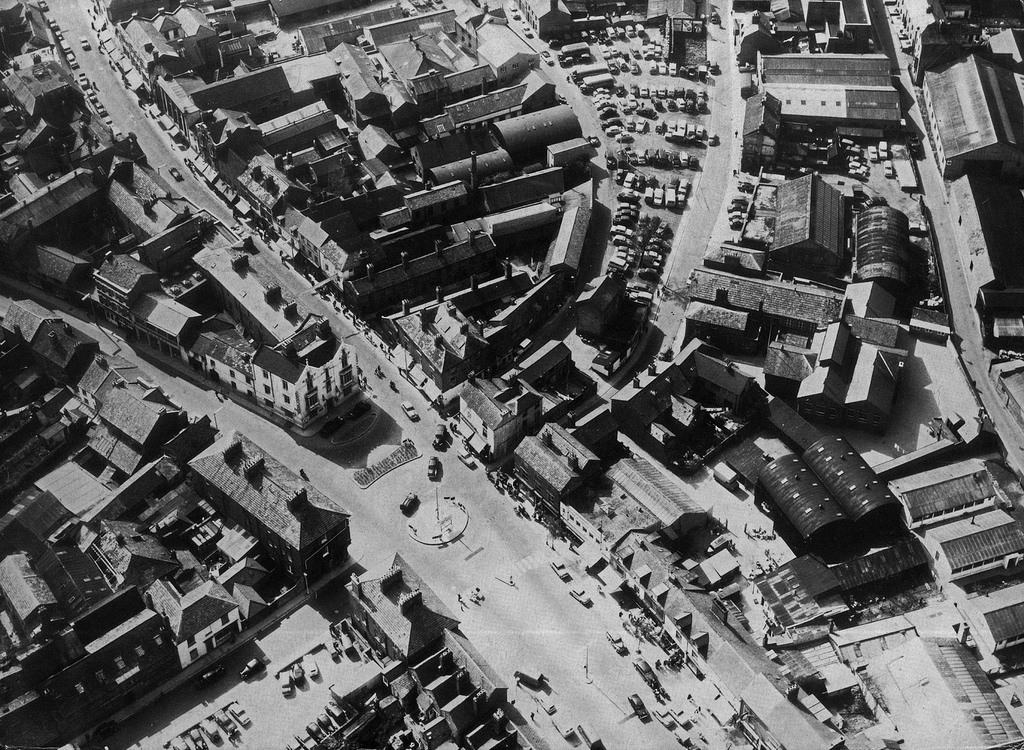
More than 15,000 images from one of the earliest and most significant collections of aerial photography of the UK, including Herefordshire, are now available to view online.


Britain from Above, a new website launched by English Heritage and the Royal Commissions on the Ancient and Historical Monuments of Scotland and Wales, features images from the Aerofilms Collection, an archive of over 1 million aerial photographs, dating from 1919 to 1953 and covering the countryside, industrial and urban landscapes, iconic landmarks and villages and coastal scenes.

Hereford Cathedral
The city of Hereford boasts a few photographs, taken mainly above the Cathedral, but also featuring High Town and the Victoria Bridge / Castle Green area, all taken in 1921.

Commercial Road, leading into High Town
One enlightened member has also created a Hereford group, and has uploaded some more gems, such as a couple of shots of the railway station at Barr’s Court Road (c. 1933) and the aerodrome (c. 1945).

The River Wye by Fiddler's Green
As for the rest of Herefordshire, the towns of Ledbury, Leominster and Ross-on-Wye are also covered extensively, and the photographer also meandered above the River Wye and took a few snaps along the way. Other landmarks include Eastnor Castle, the Malverns and Colwall, all taken in 1920/1.

Gloucester
Further afield, aerial photos of Worcester, Gloucester, Monmouth, Abergavenny, Hay-on-Wye, Ludlow and Great Malvern can be found.

All in all, this website provides a fascinating glimpse into the interwar period from a unique perspective and is definitely worth a look!

Wednesday, 6 June 2012

Jubilee local history weekend


Prior to huddling under a rain-soaked gazebo at our street party yesterday, the extra-long jubilee weekend gave me a little free time to check out a couple of local history events.

Withington Weekend

On Sunday I went back to the village where I grew up to visit a local history exhibition at St. Peter’s Church.

Here had been collected a number of artefacts, photos and newspaper cuttings reflecting life in the village over the past couple of centuries. The exhibition included various themes, some of which this blog has also touched upon and others which will no doubt appear in this humble work in the future. These included hop picking and cider making, home life, the village’s military past, the tile works, the school and railway and canal heritage.

It was great to amble back down memory lane and stumble across a number of old photos of my grandparents, my dad and also one of yours truly! Here are a few snaps from my visit:-


Of course, it was only right and proper to say hello to Nan and Granddad while I was there…


Berrington Hall WWII weekend

On Monday my family and I popped up to Berrington Hall (then realised we’d forgotten our National Trust cards, so popped home and then popped back again) to see how the jubilee was being celebrated there.

Time was short, so after doing the Marvellous Monarchs trail with the little ‘un, I snuck off to see the WWII stuff. During the war, Berrington Hall acted as a hospital, whilst also playing host to an American army camp – both of these facets were reflected at the event.

Exhibitions and re-enactors included the SOE Intelligence Gathering Office, the Historic Caravan Club and MVT and the Victorian Westerners in 1940’s period costume. Sadly by the time I arrived many re-enactors were packing up, so hopefully next year I’ll have more time to chat.

Some photos of the afternoon:-


Oh, and as for the street party – soggy, but fun!


Tuesday, 31 January 2012

The Herefordshire Light Infantry Museum

The second half of my museum day saw me at the Herefordshire Light Infantry Museum – an appointment only venue at Hereford's TA centre.


This is a great little museum, and I am indebted to David of Sunset Militaria for showing me around and imparting some of his expert knowledge. The Museum contains artefacts relevant to the Hereford Rifle Volunteer Corps (HRVC) (1860-1908), Herefordshire Regiment (1908-47) and Herefordshire Light Infantry (1947-68).


Highlights include pennants from the car of Grand Admiral Doenitz, the 2nd Fuehrer of the 3rd Reich – rescued from the officer’s mess and now given pride of place in the museum!


On display are numerous regimental standards, uniforms, cap badges at the like from the regiment’s long and distinguished history, alongside many bits and bobs ranging from photographs and drums to helmets and regimental crockery! There are also plenty of medal sets, including some rare groupings, for collectors to drool over and having such a knowledgeable guide, like David and the other trustees, adds a whole new dimension to the visit.


The Herefordshire Light Infantry Museum deserves all the support it can get and I heartily recommended making an appointment (a simple email does the trick). It is the trustees’ aim to build a larger museum dedicated to Herefordshire’s oft-overlooked military history, from its Napoleonic Volunteer militias to the SAS, and I for one fully endorse this!


A brief history of the Herefordshire Light Infantry


While Herefordshire’s connection with the regular army ended in 1881, when the 36th (Herefordshire) regiment became the 2nd Battalion, The Worcestershire Regiment, the county has a venerable association with volunteer regiments. Companies of militia and yeomanry have been raised in Herefordshire since before the Napoleonic wars and the Herefordshire Light Infantry TA proudly carried on that heritage.


The militia barracks building at Harold Street is dated 1856 and more buildings were acquired in 1890. There was a drill hall in Widemarsh Street up until the 1880’s, which was presumably superseded by a drill hall at Friars Street, which remained in use for some time. During the period other drill halls could be found scattered among the towns and villages of Herefordshire. The Harold Street barracks later became home to the county records office, with the new Suvla TA Barracks opposite.


The 1st Administrative Battalion, Herefordshire and Radnorshire Rifle Volunteers was formed in 1861, comprising  the 1st to 8th Herefordshire Rifle Volunteer Corps and the 1st to 3rd Radnorshire Rifle Volunteer Corps. In 1880 it was re-designated 1st Herefordshire (Hereford and Radnor) Rifle Volunteers and became the volunteer battalion of The King's (Shropshire Light Infantry) the next year, beginning its long association with the KSLI.


The regiment's first taste of active service came in 1900, when two Volunteer Service Companies were formed from the three Volunteer Battalions of the KSLI, of which the Herefordshire Rifle Volunteer Corps was one, to reinforce 2nd Battalion KSLI in South Africa during the Boer War. In 1908, the regiment was transferred to the Territorial Force and the title of the Regiment was changed to 'The Herefordshire Regiment TF' (although it retained two companies in Radnorshire).


In World War I the regiment was expanded to three battalions. The 1st Battalion was mobilised as part of 158 Brigade in 53rd (Welsh) Division and fought at Gallipoli, Egypt, Palestine and the Western Front. The 2nd and 3rd battalions did not see active service and were eventually absorbed into 4h (Reserve) Battalion KSLI.


The 1st battalion fought with distinction in the Great War, for example being mentioned in dispatches following the landing at Suvla Bay:-

"Some of the units which took part in this engagement acquitted themselves very bravely. The Divisional Commander speaks with appreciation of one freshly landed battalion of 53d Division, a Herefordshire battalion, which attacked with impetuosity and courage."


The battalion went on to fight in the battles of Rumani, Gaza, Beersheba, Khuweilfek, and Tel Asur, before being transferred to the western Front as part of 102 Brigade in 30 Division. Here they participated in the battles of the Marne and 3rd Ypres, earning another special mention following action near Menin:-

"Congratulations to you and all ranks of your splendid Battalion for the excellent work done during the three days fighting."


Following the armistice and a stint of garrison duty in Germany, they returned to Hereford and were demobilised in 1919. In 1920 the Reserve army was reorganised into the Territorial Army and the regiment became the Herefordshire Regiment TA, losing its Radnor companies and thus severing the long-held ties with that area. The regiment re-joined the 53rd (Welsh) Division as part of the 159 (Welsh Border) Brigade, alongside the 4th Battalion KSLI and 3rd Battalion the Monmouthshire Regiment (this after an unsuccessful attempt to turn the Herefords into a heavy artillery regiment).


The interwar years saw the regiment settling down to normal peacetime duties, including attending camp and participating in various sporting competitions, but by the late 1930's it began to modernise in preparation for another world war.


In 1939 the regiment doubled in strength, splitting up into two battalions. While the 2nd battalion was involved in anti-invasion duties and never saw action, the 1st battalion, following postings to Tenby and Northern Ireland, was reorganised with the rest of 159 Brigade into a Lorried Infantry Brigade, joining 29 Armoured Brigade in 11th Armoured Division.


Originally intended for service in North Africa, the Division eventually saw action during the Normandy landings and in Operations 'Epsom', 'Goodwood' and 'Bluecoat' and the battles around the Falaise pocket. They then participated in the thrust into Holland and fought through NW Europe, eventually reaching the Germany's Baltic Coast. Their last action was during 'Operation Blackout', where members of the Herefordshire Battalion saw the surrender of Grand Admiral Doenitz, the 2nd (and last) Fuehrer of the 3rd Reich.


Post-war reorganisations saw the Battalion reformed in 1947 to the Herefordshire Light Infantry (TA), reflecting its long association with the KSLI. The battalion continued to thrive but sadly ceased to exist after a reorganisation of the TA in 1967. Its battle honours have since been incorporated into the Light Infantry TA, a platoon of which is still stationed in Hereford.


For more information, see here and here, and this frankly fantastic forum thread here.

The VBCW perspective


Like all Territorials, the men of the Herefordshire Regiment would have had their loyalties torn at the outbreak of civil war: duty bound as soldiers to serve the King but also obliged to defend their land and loved ones against oppression.


For a loyal regiment with such a distinguished martial tradition, it might be difficult to see how they would have rebelled against the government but when the Bishop of Hereford declared for the Anglican League, members of the Herefordshire TA fought for him in some of the early battles.


In the end it must go down to the political and/or moral stance of each man and his officers. Some would have felt strongly enough to join the Anglican League, others would have marched to the nearest royalist unit, while I suspect a great many would have simply headed for home, taking their weapons and equipment with them.


This state of affairs would be a sad and ignominious end for the Regiment, and as such I invented the ‘Hereford Bulls Veterans Association’ in my first piece on VBCW Herefordshire to bring back some of their spirit and reputation. After visiting the museum I concluded that this is not enough and so, sooner or later, you will see the Herefordshire Regiment, properly represented in miniature form in this blog, ready to do battle!